How to Build a Practical Digital Transformation Roadmap
- Arcitech
- 21th October 2026
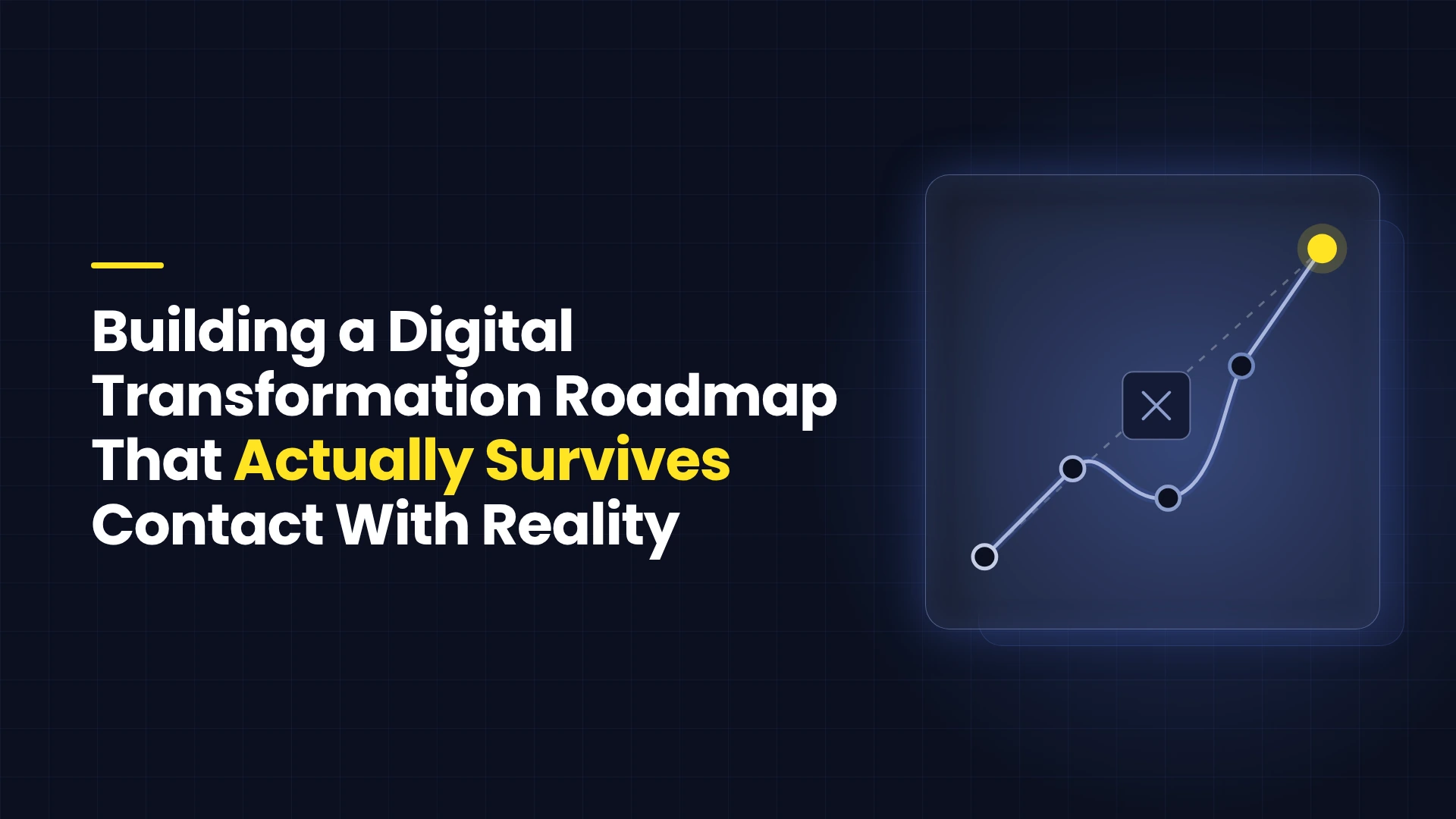
A leadership team approves a transformation programme. The presentation looks convincing: connected systems, automated processes and better customer experiences.
Then implementation begins. Customer records disagree across platforms, employees lack time for testing and an essential integration takes longer than expected. The roadmap described the destination without establishing what the organisation needed to get there.
A digital transformation roadmap connects business outcomes with sequenced changes to processes, technology, data and ways of working. It should show priorities, dependencies, ownership and the evidence needed before further investment.
A useful roadmap also makes room for discoveries that change the original plan.
What Is a Digital Transformation Roadmap
A roadmap explains how an organisation will move from its current operating model towards a defined future state.
It translates an enterprise digital transformation strategy into initiatives that teams can deliver and measure.
The strategy establishes the outcomes and choices. The roadmap establishes the sequence, responsibilities and decision points.
Technology is one component. For example, the AWS Cloud Adoption Framework groups transformation capabilities across business, people, governance, platform, security and operations. Although cloud-focused, this illustrates the breadth of organisational readiness involved.
Diagnose the Business Problem Before Listing Projects
Start with a specific operational or customer problem.
“Introduce AI” does not explain what needs to improve. “Reduce the time required to approve complete supplier invoices” identifies a process that can be investigated.
Document the current workflow, delays, rework and responsible teams.
Establish a baseline before proposing a target. Otherwise, teams may deliver software without being able to demonstrate improvement.
“Introduce AI” does not explain what needs to improve. “Reduce the time required to approve complete supplier invoices” identifies a process that can be investigated.
Document the current workflow, delays, rework and responsible teams.
| Business problem | Questions to investigate |
|---|---|
| Slow customer onboarding | Which checks and handoffs cause waiting? |
| High processing costs | Where do employees repeat work? |
| Inconsistent reporting | Which definitions and records disagree? |
| Poor service visibility | Where is status information missing? |
| Difficulty scaling | Which activities increase directly with volume? |
How to Build a Digital Transformation Roadmap
Define Outcomes and Boundaries
Choose a manageable set of outcomes and assign an accountable business owner to each.
Specify the process, customer group or business unit included. Also identify constraints such as operating hours, contractual commitments and systems that must remain available.
For a finance workflow, an outcome might be faster approval with no increase in correction rates. The target should reflect measured performance and available resources.
Assess Data Systems and People
Map the applications, interfaces and records involved in the process.
Identify who owns critical data and how disagreements between systems are resolved. Check whether existing software already supports the required capability.
Assess employee availability as well. Subject-matter experts need time for design, testing and training alongside operational responsibilities.
A technically feasible initiative can still fail if the people needed to implement it have no capacity.
Prioritise Initiatives by Value and Readiness
Evaluate opportunities using business impact, implementation effort, dependencies, operating risk and evidence quality.
Avoid treating estimated savings as guaranteed returns. Separate assumptions from measured facts. A high-value initiative with inaccessible data may need foundational work first. A smaller workflow with reliable inputs may be suitable for an early pilot.
Limit simultaneous initiatives to the organisation’s delivery and adoption capacity.
Make Dependencies Explicit
Sequence the work according to what must exist before another initiative can succeed.
Consider a hypothetical distributor planning automated order processing. Before expanding automation, it may need consistent customer identifiers, dependable product records and clear exception ownership.
Launching an AI interface first would leave those underlying problems unresolved.
A broader ERP automation approach can help identify dependencies across finance, inventory and order management.
Build a Pilot With Decision Gates
A pilot should test the assumptions behind the investment.
Define the workflow scope, representative inputs, acceptance criteria and fallback process. Include exceptions and failures rather than testing only ideal cases.
At the review point, decide whether to expand, revise or stop. Base that decision on operational results, accuracy, adoption and ongoing costs.
A successful demonstration is useful evidence, but it does not establish production readiness.
Plan Adoption and Operational Ownership
Training should explain the revised process, including what employees do when automation cannot complete a task.
Assign responsibility for support, rule changes, access permissions and performance monitoring.
Decide when the previous workflow can be retired. Keeping parallel processes indefinitely can create conflicting records and extra work.
Measure whether employees complete work through the new process, rather than counting attendance at training sessions.
Where AI Led Digital Transformation Fits
AI-led digital transformation should address work that benefits from interpretation, prediction or generation.
Examples include classifying documents, drafting responses and recommending actions. Fixed rules may be sufficient for predictable approvals and notifications.
For each AI use case, define permitted inputs, evaluation criteria and action boundaries. Use human-in-the-loop AI for uncertain or consequential decisions.
NIST’s AI Risk Management Framework organises risk-management activity around Govern, Map, Measure and Manage. It provides a useful structure for planning oversight alongside development.
Use a Roadmap That Can Change
Detail near-term work more precisely than distant initiatives.
An illustrative structure could be:
Review sequencing when evidence changes. Updating the roadmap is appropriate when new information affects feasibility or value.
An illustrative structure could be:
| Phase | Main work | Evidence needed to continue |
|---|---|---|
| Diagnose | Baselines, process mapping and readiness checks | Agreed problem and accountable owner |
| Prepare | Data, integration and control improvements | Reliable inputs and testable workflow |
| Pilot | Limited deployment and employee feedback | Acceptable outcomes, accuracy and adoption |
| Expand | Additional teams or transaction types | Stable operations and support capacity |
| Improve | Review costs, exceptions and new opportunities | Sustained business value |
KPIs That Show Business Progress
Track outcomes alongside delivery health.
Include licences, support, maintenance and review effort in cost calculations. Do not count the same benefit across several initiatives.
| KPI | What it reveals |
|---|---|
| End-to-end cycle time | Whether the process completes faster |
| Cost per completed transaction | Whether total operating effort decreases |
| Rework or correction rate | Whether quality remains acceptable |
| Workflow adoption | Whether intended users follow the new process |
| Exception resolution time | Whether difficult cases receive attention |
| Realised benefit against baseline | Whether expected value appears in practice |
Risks and Tradeoffs
Aggressive schedules can create operational disruption. Excessive caution can delay useful learning.
Balance both through limited pilots, explicit decision gates and clear accountability.
Watch for hidden dependencies, unavailable experts and projects that remain funded after their business case weakens.
Watch for hidden dependencies, unavailable experts and projects that remain funded after their business case weakens.
Turn the Roadmap Into Working Decisions
A digital transformation roadmap should guide what happens next, who owns it and what evidence justifies expansion.
Start with a measurable problem, prepare the foundations and revise the sequence as implementation reveals new information.
Arcitech’s published AI automation services include process assessment, roadmap planning, integration design and deployment support. An initial discussion can establish priorities and a practical pilot scope.
Turn Your Digital Transformation Strategy into Action
Align business priorities, connect existing systems, and build a practical transformation roadmap focused on measurable outcomes and successful adoption.
Frequently Asked Questions
1. How detailed should a digital transformation roadmap be?
Near-term initiatives need owners, dependencies and acceptance criteria. Later work can remain broader until evidence supports detailed planning.
2. Does digital transformation require replacing existing systems?
No. Process changes, configuration improvements or integrations may address the problem without a full replacement.
3. Should every roadmap include AI?
No. Include AI where its capabilities fit the task and its value can be evaluated.
4. How often should the roadmap be reviewed?
Review it at decision gates and when material assumptions change. Set a regular leadership review cadence suited to the programme.
Check out our Social Media