Human-in-the-Loop AI: When Enterprise Automation Needs Human Approval
- Arcitech
- 25th September 2026
Approving a high-value payment, rejecting an insurance claim, evaluating a job applicant, or changing critical production settings can create serious consequences if an AI system makes an incorrect decision.
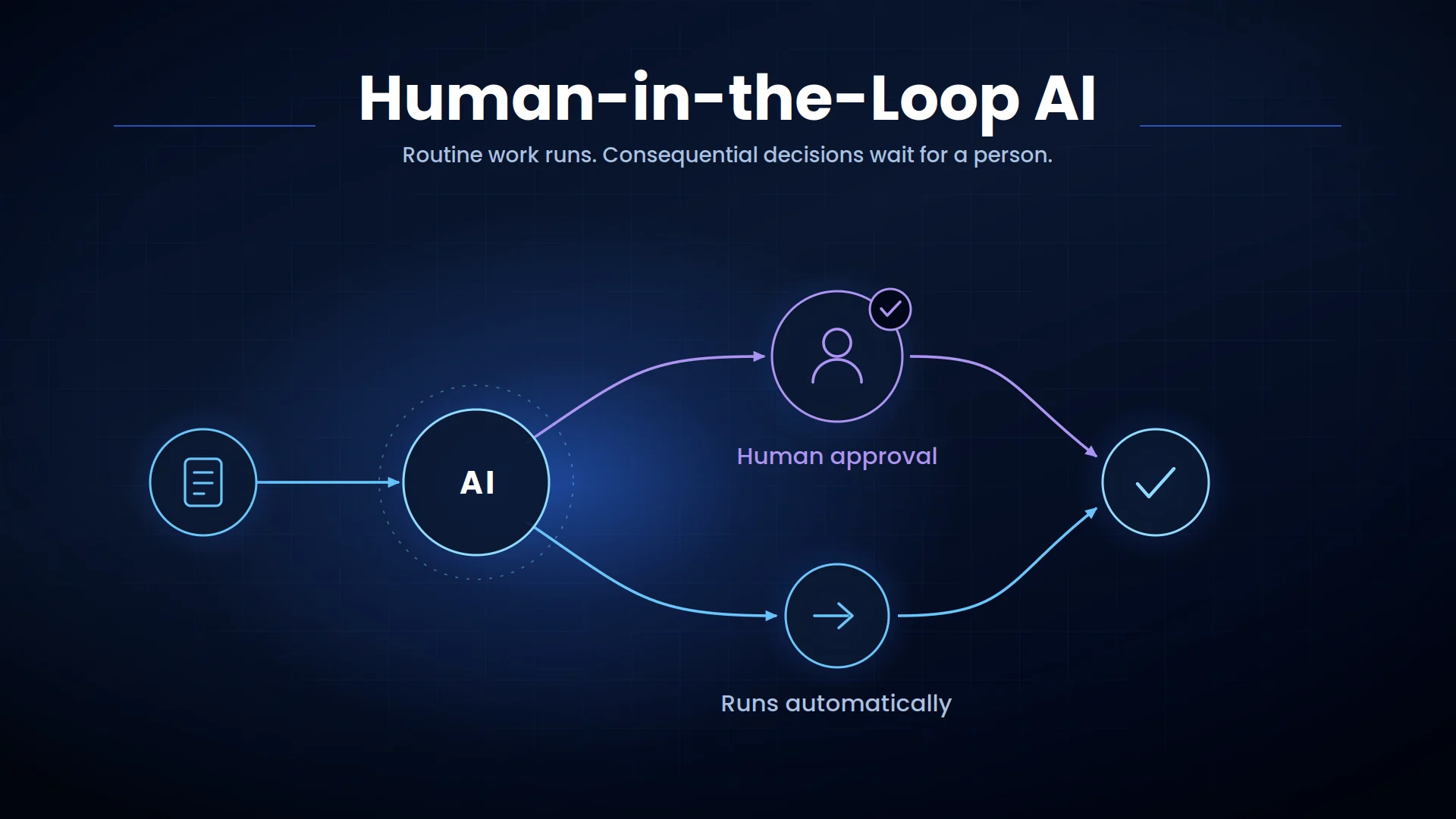
Human in the loop AI provides a practical middle ground. It allows organizations to automate predictable work while placing employees at defined approval points for uncertain, sensitive, or high-impact decisions.
What Is Human-in-the-Loop AI?
Human involvement may occur during data preparation, model training, output validation, decision approval, exception handling, or post-deployment monitoring.
In enterprise automation, HITL usually works through exception-based review. The AI processes routine cases independently but escalates a case when:
- Its confidence score falls below a defined threshold
- A transaction exceeds an approved value
- Required information is missing
- The process involves sensitive data
- The output conflicts with a business rule
- The proposed action could cause significant harm
Why Enterprise Automation Needs Human Oversight
The rise of AI agents makes human oversight even more important. Unlike systems that only provide recommendations, AI agents can interact with CRM, ERP, financial, customer-service, and workflow applications. An incorrect action may therefore affect multiple business systems.
AI human oversight is particularly important when automation involves:
- Legal, regulatory, or contractual obligations
- Financial or operational consequences
- Health and safety decisions
- Employee or customer rights
- Confidential or personal information
- Actions that are difficult to reverse
How Human-in-the-Loop Automation Works
1. The AI Analyzes the Input
2. Risk and Confidence Are Evaluated
3. Routine Cases Continue Automatically
4. Exceptions Are Escalated for Human Approval
5. Human Feedback Is Recorded
Key Business Benefits of Human-in-the-Loop AI
Greater Decision Accuracy
Lower Automation Risk
Better Auditability
Continuous System Improvement
Stronger Stakeholder Trust
Real-World Human-in-the-Loop AI Use Cases
Financial Services
Healthcare
Manufacturing
Customer Service
Human Resources
Accounts Payable
Best Practices for Implementing Human Oversight
Apply Risk-Based Approval Rules
Define Measurable Escalation Thresholds
Preserve Meaningful Human Control
Provide Reviewers With Context
Maintain Detailed Audit Logs
Monitor Business Outcomes
Conclusion
The objective is not to keep people involved in every task. It is to preserve human authority where mistakes could create meaningful financial, legal, operational, or reputational harm.
With clear approval rules, contextual review interfaces, audit trails, and performance monitoring, organizations can scale AI automation without sacrificing accountability or control.
Build Secure Human-in-the-Loop AI Workflows With Arcitech
Arcitech helps businesses design and implement secure AI approval workflows, intelligent automation systems, custom AI agents, and enterprise integrations.
Explore Arcitech’s AI automation services to automate routine processes while maintaining human oversight over critical decisions.
Frequently Asked Questions About Human-in-the-Loop AI
1. What does human in the loop mean in AI?
Human in the loop means people participate in an AI process by reviewing, approving, correcting, or overriding selected outputs and actions.
2. When should an AI system require human approval?
Human approval is most valuable for high-risk, low-confidence, regulated, sensitive, or irreversible decisions with significant business consequences.
3. Does HITL AI reduce automation efficiency?
It may slow individual exceptions, but risk-based routing keeps routine work automated while directing only uncertain or sensitive cases to employees.
4. What is the difference between HITL and human-on-the-loop AI?
HITL requires human participation at specific decision points. Human-on-the-loop systems operate more independently while people monitor performance and intervene when necessary.
5. How should enterprises measure HITL AI performance?
Important KPIs include decision accuracy, automated completion rate, escalation rate, override rate, false-positive rate, review time, incident frequency, and business impact.
Check out our Social Media