Software Development Outsourcing: The Complete Guide
- Arcitech
- 1st November 2026
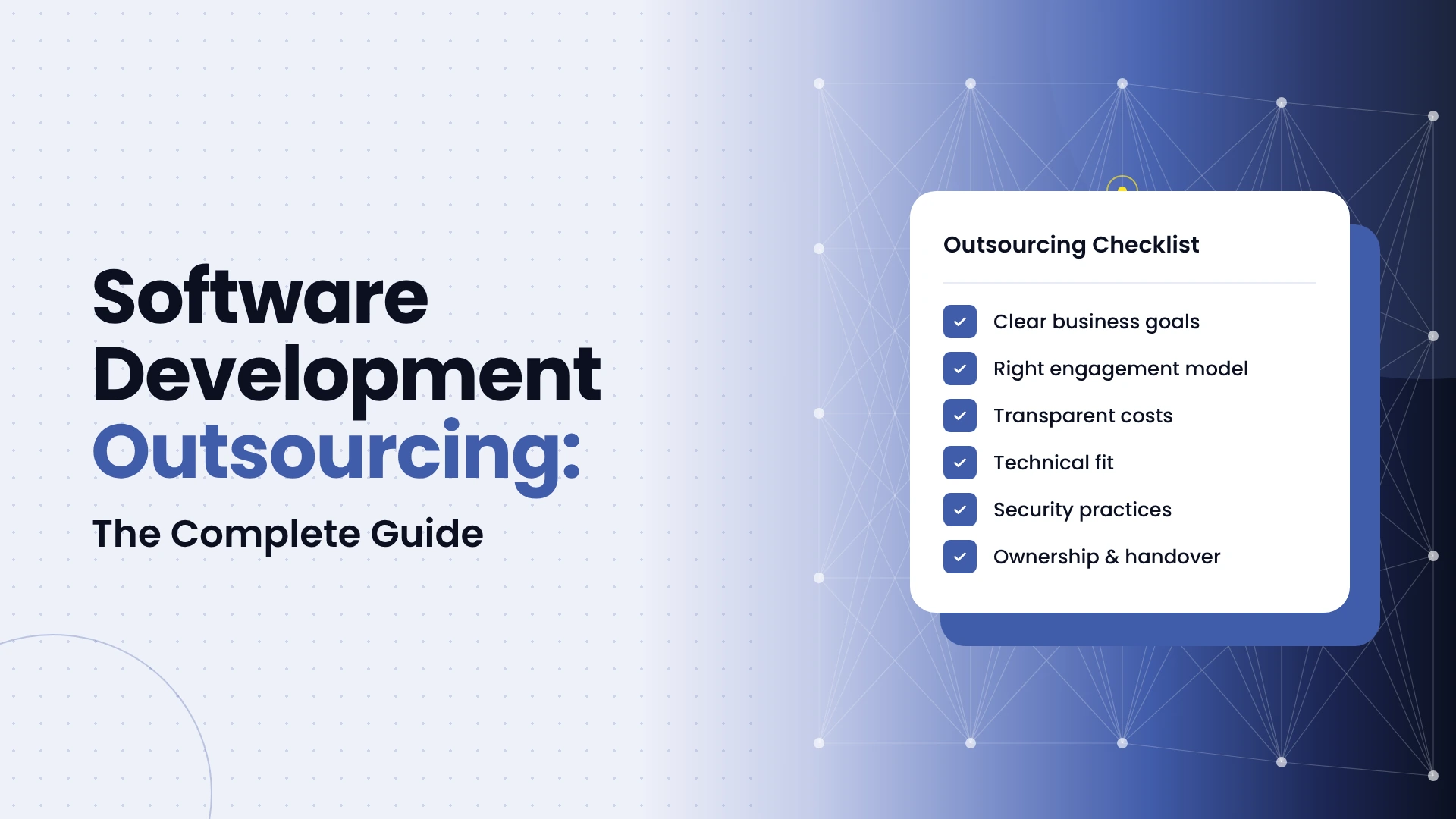
Successful outsourcing requires clear business goals, a suitable engagement model, and a partner whose delivery practices you can evaluate. This guide explains how to compare your options, estimate costs, and retain control throughout development.
When Should You Outsource Software Development?
Common situations include:
- Building an application while internal developers maintain existing systems.
- Accessing specialist architecture, integration, cloud, or AI skills.
- Adding capacity for a time-sensitive product release.
- Replacing software that creates operational bottlenecks.
If the project involves legacy application modernization, assess existing dependencies before deciding whether to rebuild, replace, or upgrade individual components.
Which Software Development Outsourcing Model Fits Your Project?
| Model | Best suited to | Buyer responsibility |
|---|---|---|
| Staff augmentation | Filling specific skill gaps | Managing developers, priorities, and delivery |
| Dedicated team | An evolving product roadmap | Providing product direction and reviewing progress |
| Project outsourcing | A defined application or release | Agreeing scope and accepting deliverables |
Nearshore vs Offshore Software Development: What Changes?
Onshore development uses a partner in the same country. Nearshore development uses a partner in a nearby country, often with overlapping working hours. Offshore development involves a more distant location, potentially with a larger time difference.
| Option | Potential advantage | Tradeoff to assess |
|---|---|---|
| Onshore | Easier scheduling and local collaboration | Whether available skills and pricing fit the project |
| Nearshore | Convenient working-hour overlap | Actual team availability and technical depth |
| Offshore | Access to a broader talent pool | Handoffs, response times, and coordination |
Choose using actual team locations, agreed working hours, communication quality, and technical capability. Geography alone cannot establish delivery quality.
How Much Does Software Development Outsourcing Cost?
Estimated delivery cost = agreed hours × blended hourly rate + separately priced expenses.
The following scenarios illustrate the calculation. They are assumptions, not market benchmarks or Arcitech quotations.
| Illustrative scope | Assumed hours | Assumed rate | Development fee |
|---|---|---|---|
| Focused prototype | 300–500 | $50/hour | $15,000–$25,000 |
| Business application release | 1,000–1,600 | $60/hour | $60,000–$96,000 |
| Larger integrated release | 2,500–4,000 | $75/hour | $187,500–$300,000 |
How Do You Evaluate a Software Outsourcing Company?
Check technical fit
Relevant experience matters more when the vendor can explain its engineering decisions and their consequences.
Verify delivery and security practices
NIST’s Secure Software Development Framework provides a reference for discussing secure development practices with suppliers. Use it to structure questions rather than assuming a vendor’s security claim proves implementation.
Confirm ownership and continuity
For AI-enabled applications, ask how the team evaluates outputs, protects data, and manages model failures.
How Can You Manage an Outsourced Development Project?
- Assign an internal product owner. Give one person authority to resolve priorities and business questions.
- Deliver in reviewable increments. Evaluate working software against agreed requirements.
- Track quality alongside progress. Review defects, reliability, and unresolved risks.
- Control scope changes. Document their effect on budget, timing, and outcomes.
- Prepare for operation. Include monitoring, documentation, support, and handover in delivery planning.
Choose a Partner You Can Evaluate
Arcitech’s custom software development services cover enterprise applications, integrations, and AI-powered systems. Share your requirements to discuss an appropriate architecture and delivery roadmap.
Build Software with the Right Partner
Get the engineering expertise to design, build, and support software around your business goals.
Frequently Asked Questions
1. What is the difference between outsourcing and staff augmentation?
Outsourcing can transfer responsibility for a project or delivery function. Staff augmentation adds external specialists to a team you manage.
2. Is offshore software development always cheaper?
No. Compare total delivery costs, including coordination, testing, rework, infrastructure, and maintenance. A lower hourly rate does not guarantee a lower project cost.
No. Compare total delivery costs, including coordination, testing, rework, infrastructure, and maintenance. A lower hourly rate does not guarantee a lower project cost.
3. Who owns outsourced software?
Ownership depends on the agreement and applicable third-party licences. Clarify rights to custom code, documentation, and reusable components before work begins.
4. Can you outsource only part of a project?
Yes. You can outsource a module, integration, testing function, or specialist task while retaining other responsibilities internally.
5. How do you reduce vendor dependency?
Maintain appropriate access to repositories and infrastructure. Require documentation, knowledge transfer, and a practical handover process throughout development.
6. Should you outsource AI software development?
It can suit projects requiring specialist expertise. Evaluate data handling, model assessment, human oversight, and production monitoring alongside conventional engineering capabilities.
Check out our Social Media