How to Choose an Enterprise Software Development Company
- Arcitech
- 3rd November 2026
Enterprise applications often connect departments, permissions, data, and business-critical workflows. A convincing demonstration is only the beginning: the system must also work within your organisation’s technical and operational constraints.
Define What Success Means Before Contacting Vendors
For example, a distributor replacing spreadsheet approvals might need an application that routes requests, checks ERP inventory, and records decisions. Success could mean faster approvals and fewer manual corrections. This is an illustrative scenario, not an Arcitech case study.
Identify requirements for availability, transaction volumes, accessibility, audit records, and recovery. These non-functional requirements influence architecture and cost even when they are invisible in a screen design.
If the work involves legacy application modernization, document existing dependencies and migration constraints before assuming a full rebuild is necessary.
What Should You Evaluate in an Enterprise Software Development Company?
Business and Workflow Understanding
Look for evidence that the team can translate operational needs into acceptance criteria. Relevant industry experience helps, but familiar terminology alone does not prove delivery capability.
Architecture and Enterprise Integrations
A strong team explains architectural tradeoffs rather than prescribing microservices or a particular cloud platform before understanding the workload. Ask what happens when an upstream system is unavailable and how failed transactions are detected and reconciled.
Security and Quality Practices
Ask which security checks produce release evidence and who approves unresolved findings. A penetration test can complement other checks, but it cannot replace secure design, implementation, and maintenance.
The Actual Delivery Team
Company-wide headcount is less informative than the experience and continuity of the people assigned to your project. Ask how knowledge is documented so that one departure does not disrupt delivery.
Production Support and Ownership
Clarify rights to custom code and any reusable components or third-party dependencies. Your team should understand what it can operate, change, and transfer if the relationship ends.
What Should the Enterprise Software Development Process Include?
| Stage | Evidence to request |
|---|---|
| Discovery | Prioritised requirements, process maps, assumptions, and acceptance criteria |
| Architecture and validation | Integration design, security considerations, and tests of risky assumptions |
| Incremental development | Working demonstrations, reviewed code, test results, and updated forecasts |
| Release preparation | Migration rehearsal, user acceptance, recovery procedures, and support readiness |
| Operation and improvement | Monitoring, incident ownership, documentation, and a prioritised improvement backlog |
Use an Evidence-Based Vendor Scorecard
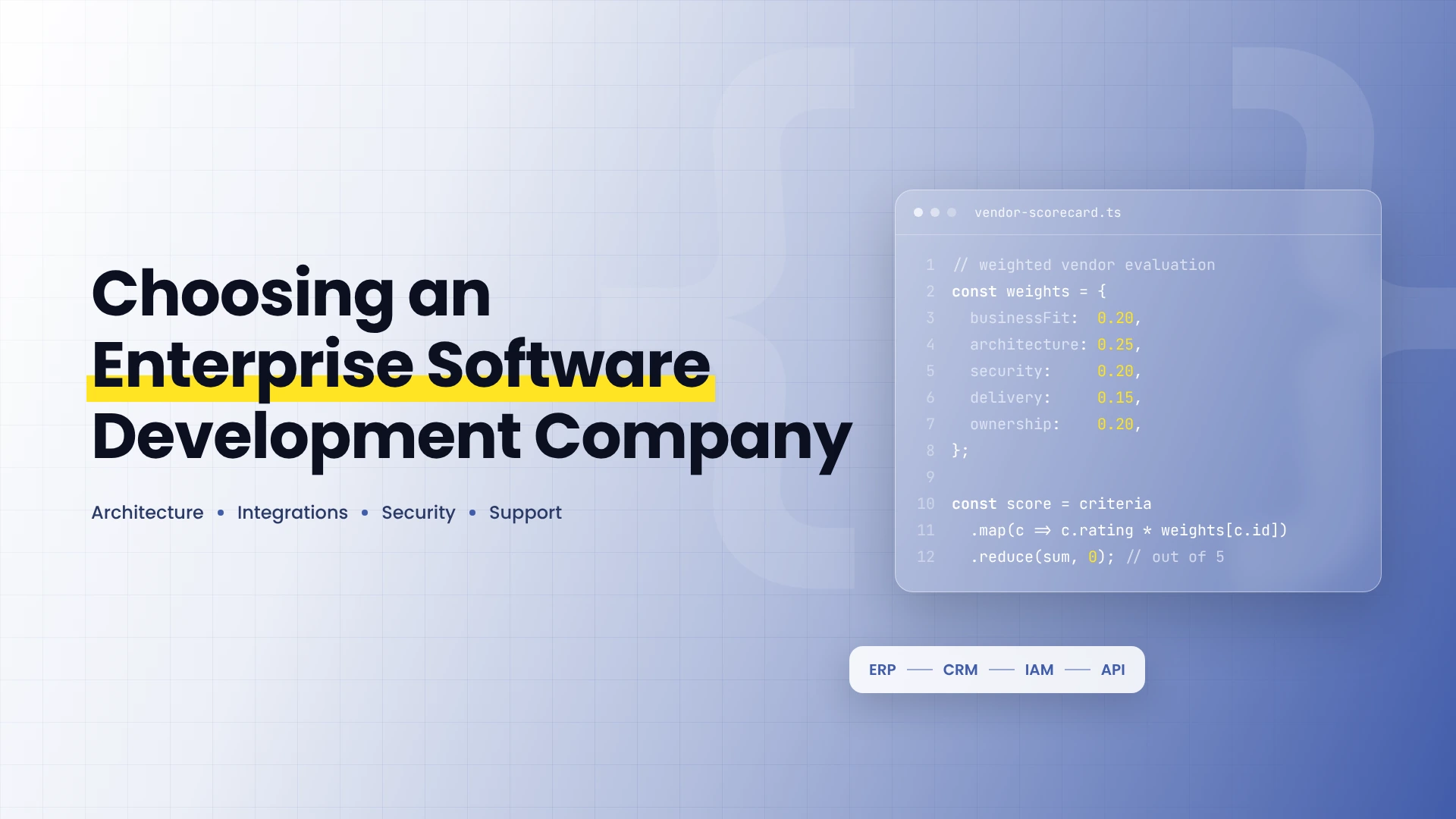
| Criterion | Suggested weight |
|---|---|
| Business fit and relevant delivery evidence | 20% |
| Architecture and integration capability | 25% |
| Security and quality practices | 20% |
| Team and delivery governance | 15% |
| Commercial clarity, ownership, and support | 20% |
Do not let a strong average conceal a critical failure. Treat unacceptable data access, missing ownership terms, or an unworkable integration approach as issues to resolve before selection.
How Do You Compare Proposals and Validate the Finalists?
A fixed-price proposal is only comparable when scope and acceptance are comparable. Time-based billing needs clear approval, reporting, and budget controls.
For the final candidates, consider a paid discovery phase or bounded technical exercise addressing a real uncertainty. For example, test whether an application can securely retrieve and reconcile records from your ERP. Agree the deliverables and evaluation criteria in advance.
Request references where available and ask about changes, difficult releases, and support after launch. These discussions can reveal more than a polished project summary.
Choose a Partner Whose Decisions You Can Evaluate
Arcitech’s custom software development services cover enterprise applications, ERP and CRM solutions, APIs, and AI-powered software. Share your workflows and integration requirements to discuss an appropriate architecture and delivery roadmap.
Build Software for Your Enterprise
Connect workflows, data, and systems with secure software designed around your organisation’s needs.
Frequently Asked Questions
1. What makes enterprise software development different?
Enterprise projects commonly involve interconnected systems, complex permissions, multiple stakeholders, and demanding operational requirements. Complexity depends on the environment, not simply company size.
2. Should you choose a vendor with industry experience?
Relevant experience can help, but verify the team’s understanding and delivery evidence. Industry familiarity should complement technical capability and clear communication.
3. How many vendors should you shortlist?
There is no universal number. Choose a manageable group that you can assess consistently and in sufficient depth.
4. Is the lowest proposal the best value?
Only if its scope, quality, responsibilities, and ongoing costs meet your needs. Check exclusions before comparing totals.
5. Who should own the source code?
Define rights to custom code, documentation, reusable components, and dependencies in the agreement. Repository access alone does not establish ownership.
6. Is a technical pilot always necessary?
No. Use one when a significant uncertainty warrants validation. A focused paid discovery exercise may be more useful than a generic demonstration.
Check out our Social Media