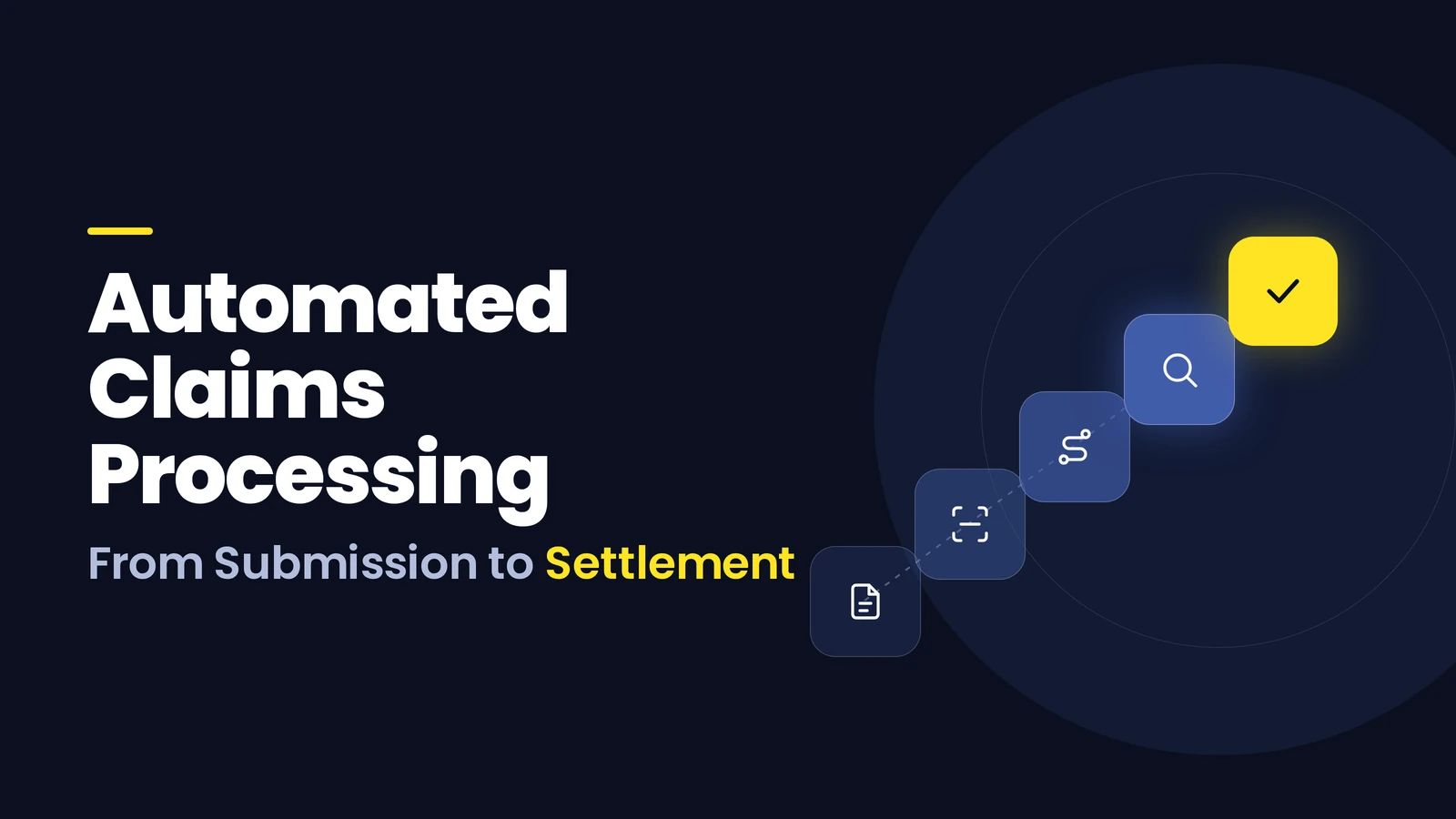
How Automated Claims Processing Works From Submission to Settlement
- Arcitech
- 18th October 2026
A policyholder submits a claim online, but the handling team still downloads attachments, checks records and emails another department for missing information. The submission is digital; the work behind it remains fragmented.
Automated claims processing connects claim intake, document checks, task routing, assessment support and payment workflows. It reduces repetitive administration while directing uncertain or consequential decisions to authorised employees.
The objective is a dependable process that moves each claim forward with clear evidence, ownership and controls.
What Is Automated Claims Processing
Automated claims processing uses software, business rules and integrations to coordinate activities across the claim lifecycle.
Claims automation software can register submissions, extract document details, identify missing information, assign work and update claim status.
AI claims processing adds capabilities such as interpreting unstructured documents, summarising correspondence or identifying patterns for investigation. The NAIC identifies claims applications including accident-image analysis, settlement-value estimation and fraud detection. These uses support different parts of the process and require appropriate validation.
Automation should distinguish between recording evidence, recommending an outcome and authorising a decision.
Diagnose Why Claims Get Stuck
A long settlement time may reflect incomplete submissions, unclear ownership or a backlog of specialist reviews.
Before selecting technology, examine where claims wait and why handlers repeat work.
Measure waiting time separately from active handling time. Faster document extraction will have limited impact if a claim then waits several days for assignment.
Before selecting technology, examine where claims wait and why handlers repeat work.
| Recurring problem | Appropriate starting point |
|---|---|
| Missing documents trigger repeated follow-ups | Submission guidance and completeness checks |
| Handlers re-enter information | Document extraction and system integration |
| Claims reach the wrong queue | Classification and assignment rules |
| Decisions lack supporting evidence | Structured review records and approval controls |
| Approved payments remain outstanding | Payment-status tracking and reconciliation |
How the Automated Claims Workflow Works
Submission and Claim Registration
The workflow captures the initial notification, creates a claim reference and acknowledges receipt.
Validate essential identifiers and preserve the original submission. Where possible, connect later correspondence to the existing claim rather than creating duplicate records.
Make the acknowledgement clear: receiving a submission does not establish coverage or confirm that every required document has arrived.
Document Extraction and Completeness Checks
AI-assisted extraction can populate fields from forms, invoices, estimates and correspondence.
Check extracted details against source documents and trusted records. Unclear dates, conflicting amounts or uncertain policy matches should trigger review.
Completeness checks should reflect the claim type and processing stage. Avoid sending generic requests for documents already supplied. A useful missing-information task explains what is needed, why it is relevant and who owns the follow-up.
Classification and Assignment
Rules can assign claims according to product, location, complexity and staff authority.
AI may help classify open-ended descriptions, but routing should remain testable. An uncertain category should reach a review queue rather than silently determine the handling path.
Monitor whether supposedly routine claims repeatedly require reassignment. That pattern may indicate an inadequate classification scheme.
Assessment and Investigation Support
AI claims processing can organise evidence, draft summaries and flag inconsistencies for investigation.
Consider a hypothetical motor claim where a repair estimate lists different vehicle details from the submitted policy record. The workflow should highlight the discrepancy and display both sources.
The mismatch may be an administrative error. It should not automatically become a fraud finding or rejection.
Use human-in-the-loop AI for disputed evidence, sensitive findings and decisions requiring professional judgment.
Settlement Approval and Communication
A proposed settlement needs traceable inputs, applicable policy terms and the correct approval authority.
Generated explanations should remain grounded in the actual claim record. Review communications that contain a denial, disputed valuation or consequential policy interpretation.
In the US, the NAIC’s adopted AI Model Bulletin sets expectations for responsible AI governance and reminds insurers that AI-supported actions must comply with applicable insurance laws. Its implementation depends on the jurisdiction; it is not a single nationwide claims rule. [2, 3]
Payment and Reconciliation
An approved settlement is not the same as a completed payment.
Validate the payee, payment details and approval status. Apply additional verification to payment-detail changes.
Track failed or returned payments, and prevent retries from creating duplicates. Reconcile payment results with the claim record before marking the relevant financial step complete.
Validate the payee, payment details and approval status. Apply additional verification to payment-detail changes.
Track failed or returned payments, and prevent retries from creating duplicates. Reconcile payment results with the claim record before marking the relevant financial step complete.
What Claims Automation Software Can Improve
Less Repetitive Handling
Connected workflows can reduce downloading, copying and manual task creation. Handlers gain capacity for investigation and policyholder communication.
More Consistent Processing
Configured checks help teams apply required administrative steps consistently. Exceptions still need clear ownership and authority.
Better Status Visibility
A claim record should show what is outstanding, who owns the next action and how long it has waited.
Stronger Review Evidence
Preserving documents, recommendations and approvals makes it easier to understand how an outcome was reached.
Risks and Tradeoffs
Incorrect Extraction Can Affect Later Decisions
A small error in a date, amount or identifier may spread through the workflow. Validate critical fields before consequential actions.
Historical Data May Contain Bias
Past outcomes are not automatically suitable targets for a model. Test performance across relevant claim types and customer groups, and investigate unexplained differences.
Integration Failures Can Hide Work
A task created in one system may never reach another. Confirm successful updates, monitor failures and define recovery ownership.
More Automation Can Create More Exceptions
A poorly configured workflow may reduce data entry while overwhelming reviewers with alerts.
Measure confirmed issues and reviewer workload alongside automation rates. Include maintenance and oversight costs when assessing value.
Measure confirmed issues and reviewer workload alongside automation rates. Include maintenance and oversight costs when assessing value.
Implementation Steps and KPIs
Pilot one claim type and a defined workflow stage. Establish baseline performance, then test missing documents, duplicate submissions, conflicting records and failed payments.
Review results by claim complexity. A changing mix of routine and complex claims can distort overall averages.
| KPI | What it measures |
|---|---|
| Submission completeness rate | Whether claims arrive with required information |
| Time to assignment | How quickly a handler receives the claim |
| Manual handling time | Staff effort per claim or workflow stage |
| Exception resolution time | How quickly flagged issues are resolved |
| Reopening or correction rate | Whether completed work requires revision |
| Settlement payment turnaround | Time from authorised settlement to completed payment |
Build a Reliable Route to Settlement
Automated claims processing works best when it removes a defined bottleneck while preserving evidence and accountability.
Start with a manageable stage, prove accuracy and recovery procedures, then expand.
Arcitech’s published AI automation services cover business workflows and enterprise integration planning. A relevant starting discussion is mapping claim handoffs, system connections and approval requirements.
Start with a manageable stage, prove accuracy and recovery procedures, then expand.
Arcitech’s published AI automation services cover business workflows and enterprise integration planning. A relevant starting discussion is mapping claim handoffs, system connections and approval requirements.
Streamline Your Claims Processing Workflows
Automate claims intake, simplify document verification, and connect approval workflows to reduce processing delays while maintaining oversight of complex cases.
Frequently Asked Questions
1. Does automated claims processing require AI?
No. Rules and integrations can handle predictable tasks. AI is more useful when documents or descriptions require interpretation.
2. Can every claim be processed without human involvement?
No. Suitability depends on complexity, evidence, authority and applicable requirements. Exceptions need an appropriate review route.
3. Does a fraud alert prove that a claim is fraudulent?
No. An alert identifies a case for investigation. Findings must be supported by evidence and appropriate review.
4. What should insurers automate first?
Choose a repetitive stage with reliable inputs and measurable delays, such as registration, document checks or task assignment.
Check out our Social Media