Procurement Automation: AI Use Cases Across Purchase-to-Pay
- Arcitech
- 05th October 2026
Employees may buy from unapproved suppliers, approvers may overlook urgent requests, and finance teams may receive invoices that cannot be matched to valid purchase orders.
Procurement automation connects these activities within a controlled digital workflow. Artificial intelligence extends this capability by interpreting supplier documents, identifying risks, recommending vendors, detecting anomalies, and assisting employees across the purchase-to-pay lifecycle.
What Is Procurement Automation?
It can support processes including:
- Purchase requisition creation
- Approval routing
- Supplier discovery and onboarding
- Request-for-quotation management
- Contract review
- Purchase order generation
- Delivery and receipt tracking
- Invoice matching
- Exception management
- Spend analysis
Procurement Automation Across Purchase-to-Pay
1. Purchase Request Intake
AI can identify the requested product or service, suggest a category, recommend approved suppliers, and check whether an existing contract or catalog item already meets the requirement.
Business impact: Fewer incomplete requests, improved policy compliance, and faster requisition creation.
2. Requisition Approval
Routine purchases within approved limits can proceed through simplified approvals. High-value, unusual, or noncontracted purchases can be escalated to procurement, finance, or legal teams.
Business impact: Shorter approval cycles and clearer accountability.
3. Supplier Discovery and Selection
During a sourcing event, it can structure responses and compare prices, delivery terms, quality standards, certifications, and contractual conditions. Procurement professionals remain responsible for supplier selection and negotiation.
Business impact: Faster supplier evaluation and more consistent sourcing decisions.
4. Supplier Onboarding
The system can validate whether information is complete and route exceptions to the appropriate team. Changes to sensitive details, particularly payment information, should require independent verification.
Business impact: Faster onboarding with stronger supplier-data controls.
5. Contract Analysis
AI can compare proposed language with approved templates and flag unusual terms for legal or procurement review.
Business impact: Reduced review time and better visibility into contractual obligations.
6. Purchase Order Automation
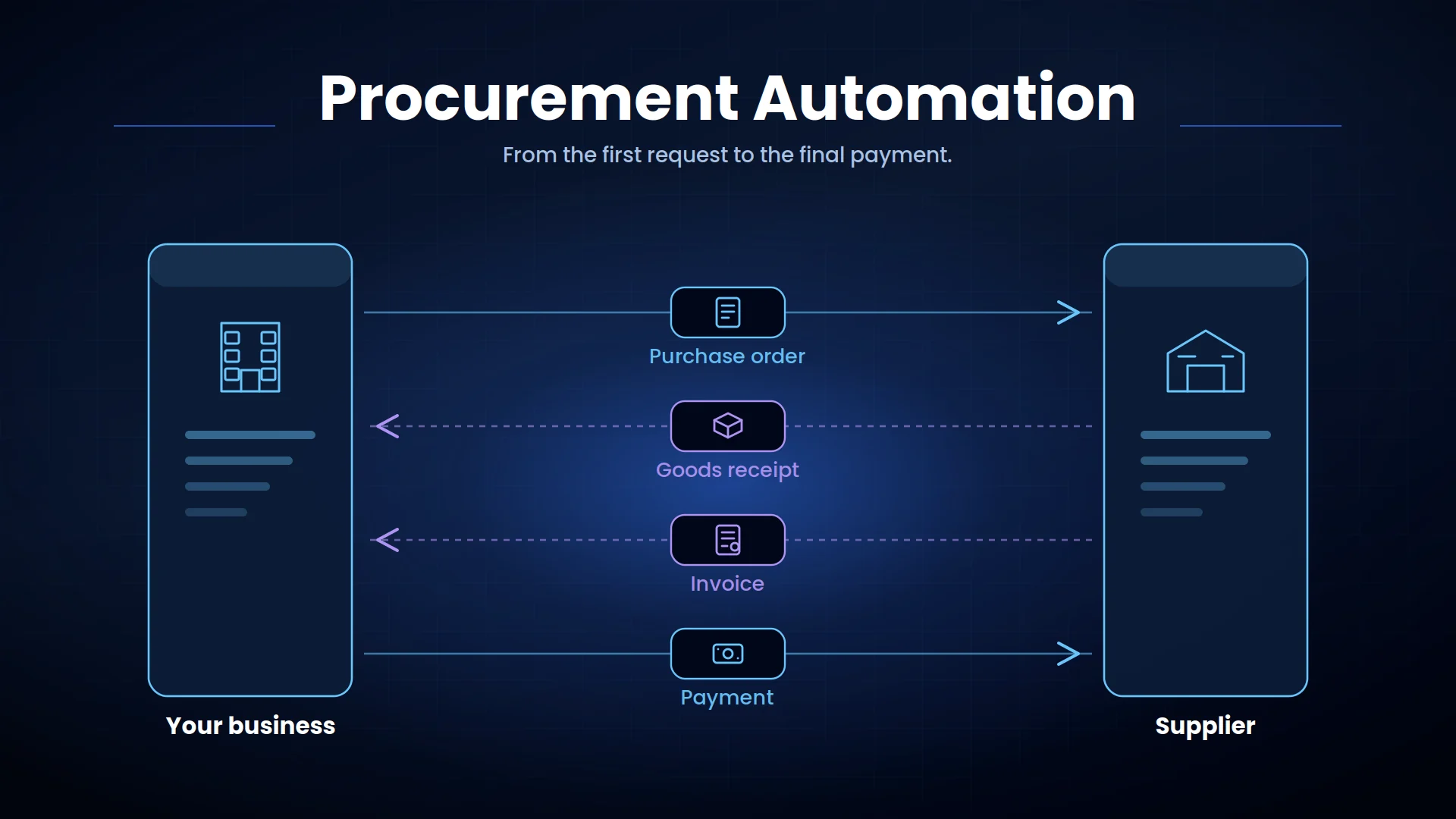
The purchase order is sent to the supplier and recorded in the ERP or procurement system. Order acknowledgements can then be compared with the original PO to detect changes in quantity, price, or delivery date.
Business impact: Fewer order-entry errors and reduced purchasing delays.
7. Goods Receipt and Delivery Tracking
Late, incomplete, or unexpected deliveries can trigger alerts and supplier follow-up tasks.
Business impact: Better delivery visibility and faster issue resolution.
8. Invoice Matching and Exception Handling
The workflow performs two-way matching against the purchase order or three-way matching against the purchase order and goods receipt. Invoices within established tolerance levels can proceed automatically.
Price differences, duplicate invoices, missing receipts, or changed bank details are routed for review.
Business impact: Higher touchless-processing rates and fewer incorrect payments.
Emerging AI Use Cases in Procurement
Current enterprise platforms reflect this direction. SAP’s procurement platform describes AI-supported intake, sourcing, supplier management, purchasing, invoice matching, and exception handling. Oracle Procurement similarly incorporates AI-assisted sourcing, policy guidance, supplier management, quote-to-requisition workflows, and invoice automation.
These capabilities should operate within clear permission boundaries. AI may recommend a supplier or prepare a purchase order, but high-value commitments and sensitive supplier changes should retain human approval.
Key Benefits of Procure-to-Pay Automation
Lower Processing Costs
Better Spend Control
Faster Procurement Cycles
Reduced Errors and Fraud Risk
Improved Supplier Performance
Best Practices for Procurement Automation
Standardize supplier and item data. Poor master data can prevent accurate matching and create unnecessary exceptions.
Integrate procurement workflows with ERP, finance, inventory, contract, and supplier-management systems.
Disconnected automation simply moves manual work to another stage. Use role-based access and separation of duties. Requesting, approving, receiving, changing supplier data, and authorizing payment should not be controlled by one user or agent.
Begin with a defined process such as purchase-order creation or invoice matching. Measure results before expanding across the entire procurement lifecycle.
KPIs for Measuring Procurement Automation
- Purchase requisition cycle time
- Purchase order creation time
- Approval turnaround time
- Percentage of spend with approved suppliers
- Contract-compliant spend
- Touchless invoice-processing rate
- Invoice exception rate
- Cost per purchase order
- Supplier onboarding time
- Savings and avoided costs
Conclusion
The objective is not uncontrolled purchasing autonomy. It is faster execution with better data, policy compliance, supplier visibility, and financial control.
Automate Purchase-to-Pay Workflows With Arcitech
Arcitech’s AI automation services help businesses automate procurement intake, approvals, purchase orders, supplier documents, invoice matching, and exception management.
Our AI integration services connect procurement workflows with ERP, finance, inventory, and supplier-management platforms.
Talk to Arcitech about building a secure procurement automation solution around your current systems and approval policies.
Frequently Asked Questions About Procurement Automation
1. What is procurement automation?
Procurement automation uses software and AI to streamline purchasing, supplier management, approvals, purchase orders, receiving, and invoice processing.
2. What is purchase-to-pay automation?
It automates the process from purchase request and approval through ordering, receipt, invoice matching, and payment preparation.
3. How does AI improve procurement?
AI can interpret documents, compare supplier responses, identify risks, recommend actions, detect anomalies, and assist with procurement decisions.
4. Can purchase orders be created automatically?
Yes. Approved requisitions can generate purchase orders using validated supplier, pricing, accounting, and delivery information.
5. Which procurement actions should require human approval?
High-value purchases, supplier selection, unusual contract terms, bank-detail changes, exceptions, and payment authorization should retain appropriate human oversight.
Check out our Social Media