AI in Manufacturing: The Intelligent Revolution in Industry
- Arcitech
- 04th August 2026
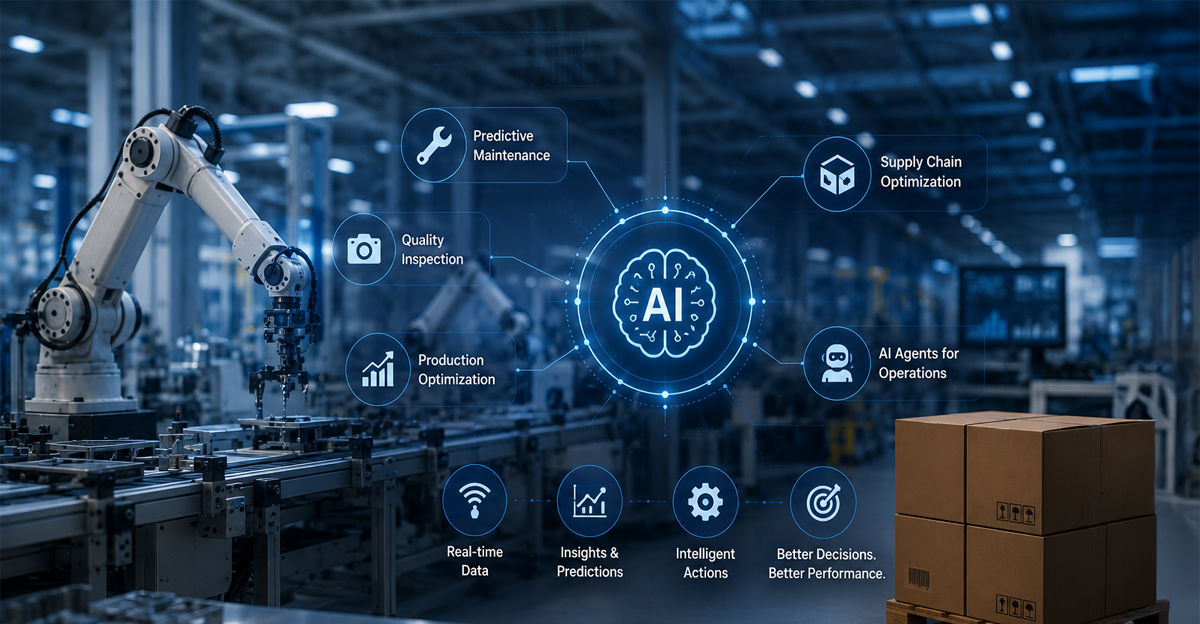
Manufacturers have used automation for decades to improve production speed, consistency, and safety. Traditional automation, however, usually follows predefined instructions and cannot easily respond when equipment behavior, material quality, customer demand, or production conditions change. AI in manufacturing introduces a more intelligent approach. It enables machines and software systems to analyze operational data, identify patterns, predict problems, and recommend or initiate actions in real time. From predicting equipment failures to inspecting products with computer vision, artificial intelligence is helping manufacturers create more connected, efficient, and responsive operations. The objective is not to replace experienced operators. It is to give them better information, reduce repetitive work, and improve decisions across the factory.
What Is AI in Manufacturing?
- Industrial Internet of Things sensors
- Programmable logic controllers
- SCADA systems
- Manufacturing execution systems
- Enterprise resource planning platforms
- Warehouse management systems
- Quality management software
- Computerized maintenance management systems
How AI Is Transforming Manufacturing Operations
Predictive Maintenance
- Reduce unexpected equipment failures
- Improve maintenance planning
- Extend asset life
- Reduce unnecessary maintenance
- Improve spare-parts availability
Automated Quality Inspection
Production Planning and Scheduling
Supply Chain and Inventory Optimization
AI Agents for Manufacturing Operations
For example, an AI agent may detect a production delay, review machine availability, check material inventory, suggest a revised schedule, update the manufacturing execution system, and notify the production supervisor.
Agents can also support:
- Maintenance case preparation
- Work-order creation
- Production report generation
- Supplier communication
- Quality incident investigation
- Standard operating procedure retrieval
Traditional Automation vs AI-Powered Manufacturing
| Area | Traditional Automation | AI-Powered Manufacturing |
|---|---|---|
| Decision logic | Fixed instructions | Data-driven recommendations |
| Response to change | Requires reprogramming | Adapts to operational patterns |
| Maintenance | Calendar-based | Condition and prediction-based |
| Quality inspection | Manual or rule-based | Computer vision and pattern analysis |
| Production planning | Static schedules | Dynamic optimization |
| Exception management | Manual investigation | Automated classification and prioritization |
| Data usage | Limited operational signals | Connected operational and enterprise data |
Business Benefits of AI in Manufacturing
- Reduced unplanned downtime
- Faster identification of quality problems
- Improved production throughput
- Lower scrap and rework
- Better inventory management
- More accurate demand forecasting
- Faster operational decision-making
- Improved employee productivity
- Greater visibility across factories
Challenges of Implementing Manufacturing AI
- Poor or inconsistent operational data
- Limited integration between IT and operational technology
- Insufficient historical failure or defect data
- Lack of internal AI expertise
- Resistance to changing established workflows
- Cybersecurity risks
- Unclear ownership of AI decisions
- Difficulty scaling a pilot across multiple facilities
Security and Governance Requirements
- Who owns each AI system
- What data the system may use
- Which actions require human approval
- How predictions will be validated
- How model performance will be monitored
- How employees can override recommendations
- What happens when the AI system becomes unavailable
How to Implement AI in Manufacturing
Step 1: Choose a Measurable Use Case
Step 2: Establish Baseline Performance
Step 3: Connect Operational Data
Step 4: Run a Controlled Pilot
Step 5: Integrate AI Into Daily Workflows
Step 6: Scale After Proving Value
KPIs for Manufacturing AI
- Unplanned downtime
- Overall equipment effectiveness
- Mean time between failures
- Mean time to repair
- Defect and scrap rates
- First-pass yield
- Production cycle time
- Forecast accuracy
- Energy consumption per unit
- AI alert accuracy
- Human override rate
- Return on investment
Conclusion
Successful implementation requires reliable data, secure integrations, clear objectives, employee involvement, and strong governance. Starting with focused operational challenges allows manufacturers to scale proven AI solutions and achieve sustainable performance.
Build Intelligent Manufacturing Systems With Arcitech
Arcitech builds AI automation, industrial automation, enterprise integrations, and custom manufacturing software that improve efficiency, quality, and production performance.
Frequently Asked Questions
1. Will AI replace manufacturing workers?
AI is more likely to change job responsibilities than replace complete manufacturing teams. It can automate repetitive monitoring and analysis while employees manage equipment, exceptions, safety, quality, and process improvement.
2. What is the best first AI use case in manufacturing?
Predictive maintenance and visual quality inspection are common starting points because their outcomes can be measured through downtime, maintenance costs, defects, and scrap.
3. Can AI work with legacy manufacturing equipment?
Yes. Sensors, industrial gateways, APIs, middleware, and custom integrations can connect AI systems with older equipment. The appropriate approach depends on machine interfaces and operational requirements.
4. Is manufacturing AI secure?
It can be secure when implemented with network segmentation, access controls, encryption, monitoring, incident response, and industrial cybersecurity practices. Security must be designed into the system from the beginning.
5. How long does an AI manufacturing project take?
A focused pilot may take several weeks or months. Wider implementation depends on data readiness, equipment connectivity, system integrations, testing, security reviews, and the number of facilities involved.
Check out our Social Media