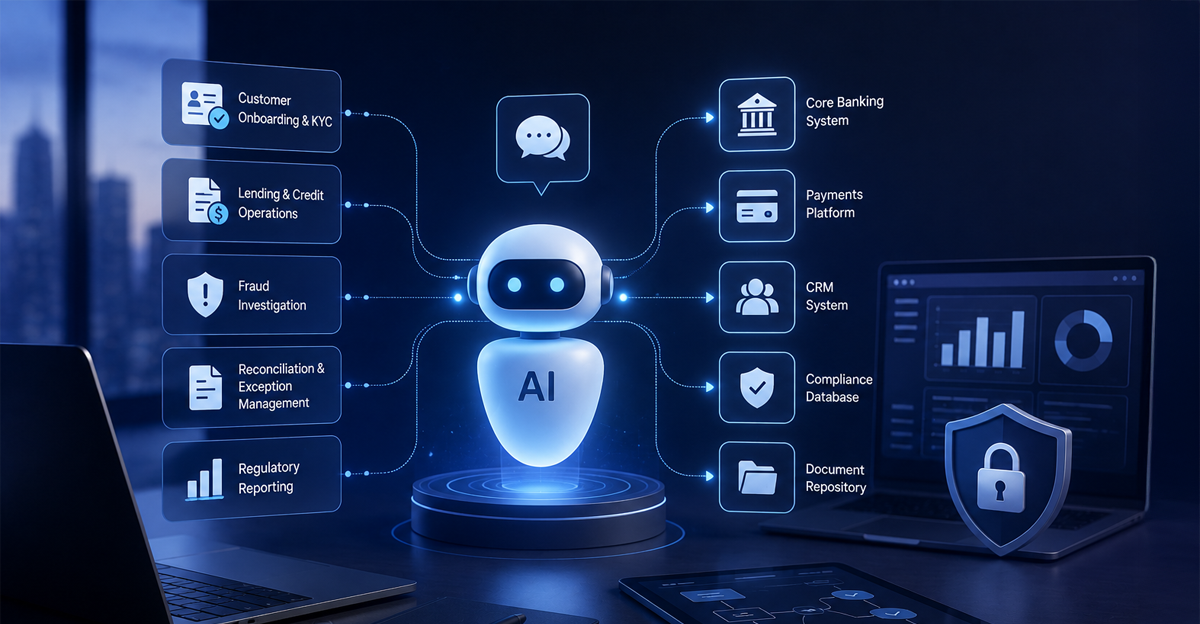
AI Automation in FinTech: A Complete Guide for Financial Institutions
- Arcitech
- 03rd August 2026
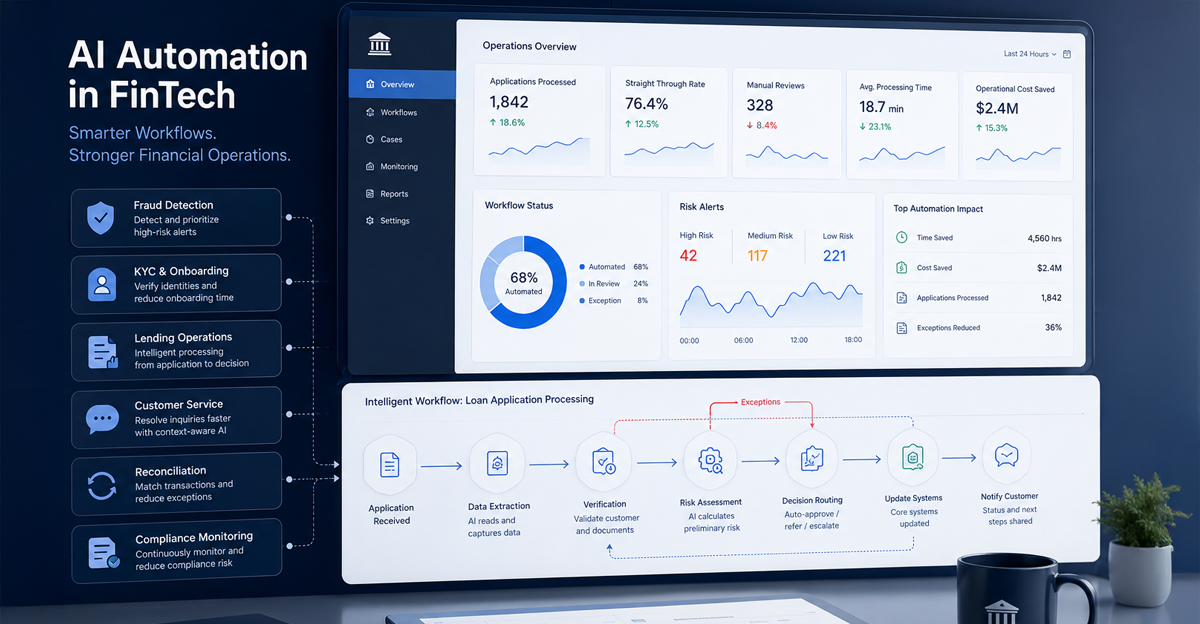
Financial institutions process enormous volumes of transactions, documents, customer requests, compliance checks, and risk alerts every day. When these processes depend heavily on manual work, operations become slower, more expensive, and increasingly difficult to scale.
AI automation in FinTech helps banks, lenders, payment providers, insurance companies, and financial technology businesses automate repetitive tasks while improving the speed and consistency of decision-making.
Unlike traditional automation, which follows fixed rules, AI-powered automation can analyze documents, identify patterns, understand customer requests, prioritize risks, and recommend suitable actions. When implemented responsibly, it enables financial teams to focus on complex decisions while automated systems manage routine work.
What Is AI Automation in FinTech?
AI agents. Perform multi-step tasks, make context-based decisions, and coordinate actions across different tools and systems — see AI agents in FinTech for a closer look at this shift toward autonomous financial operations.
It combines technologies such as:
- Machine learning. Enables financial systems to identify patterns, learn from historical data, and improve decisions over time.
- Natural language processing. Helps systems understand, analyze, and respond to written or spoken financial information.
- Intelligent document processing. Extracts, validates, and organizes information from documents such as loan applications, invoices, statements, and identity records.
- Robotic process automation. Automates repetitive, rule-based tasks across financial systems and applications.
- Predictive analytics. Uses historical and real-time data to forecast outcomes, identify risks, and support financial decision-making.
- AI agents. Perform multi-step tasks, make context-based decisions, and coordinate actions across different tools and systems.
- Enterprise system integrations. Connect AI-powered workflows with platforms such as CRM, ERP, banking, loan management, and compliance systems.
Why Financial Institutions Are Adopting AI Automation
- Faster transaction and application processing. Automates repetitive tasks to reduce turnaround times and improve service delivery.
- Reduced manual data entry. Minimizes repetitive input tasks, reducing errors and freeing employees for higher-value work.
- More consistent operational decisions. Applies standardized rules and AI-driven insights to improve decision accuracy across processes.
- Improved fraud and risk detection. Analyzes large volumes of data to identify suspicious activities and potential risks more effectively.
- Lower processing costs. Reduces operational expenses by automating labor-intensive workflows.
- Better customer response times. Enables faster handling of requests, approvals, and support inquiries.
- Greater visibility into operational performance. Provides real-time monitoring, reporting, and insights into workflow efficiency and bottlenecks.
- Improved employee productivity. Allows teams to focus on strategic, customer-facing, and decision-making activities instead of routine administrative tasks.
Key Use Cases of AI Automation in FinTech
Fraud Detection and Alert Prioritization
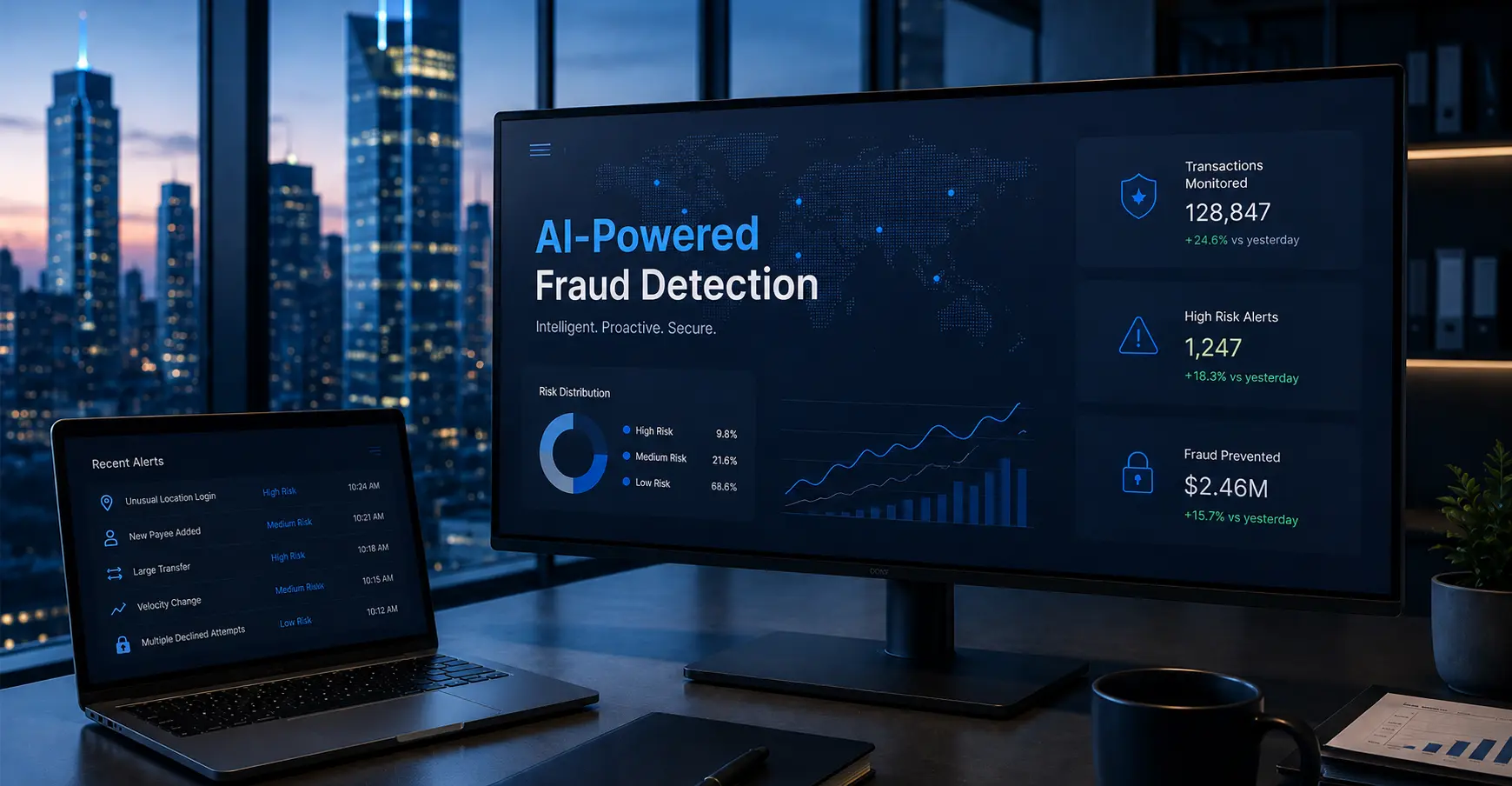
AI can evaluate transaction patterns, account behavior, customer history, location signals, device information, and previous fraud cases. It can then prioritize alerts based on their potential level of risk.
This allows investigators to focus on high-risk cases rather than spending equal time on every alert.
Human review should remain part of the process when an automated recommendation could block an account, reject a transaction, or affect a customer significantly.
KYC and Customer Onboarding
- Extract information from identity documents. Captures relevant customer details from passports, identification cards, and other supporting documents.
- Compare details across multiple systems. Verifies customer information against internal records, databases, and third-party sources.
- Identify missing or inconsistent information. Flags incomplete applications, mismatched data, and potential documentation issues.
- Conduct preliminary compliance checks. Screens customer information against predefined rules, watchlists, and risk criteria.
- Route exceptions to compliance teams. Sends unusual, high-risk, or unresolved cases to specialists for further review.
- Update customer records automatically. Transfers verified information into customer management and compliance systems.
Lending and Credit Operations
Customer Service Automation
AI-powered customer service systems can understand the purpose of an inquiry and route the customer to the correct department — often through the same channels covered by secure fintech mobile app development .
For sensitive or complex requests, the system should transfer the conversation to a trained employee with the relevant context already available.
Reconciliation and Finance Operations
| Area | Traditional Automation | AI Automation |
|---|---|---|
| Decision logic | Fixed rules | Learns from patterns and data |
| Data handling | Structured data | Structured and unstructured data |
| Documents | Requires standard formats | Can interpret varied documents |
| Customer inquiries | Keyword-based responses | Understands intent and context |
| Risk detection | Predefined conditions | Identifies complex patterns |
| Exceptions | Often requires manual handling | Can classify and prioritize exceptions |
| Adaptability | Limited | Improves through testing and refinement |
Traditional Automation vs AI Automation in FinTech
Risks and Governance Requirements
- Biased or inconsistent outputs. AI systems may produce unfair or uneven results across different customers, groups, or use cases.
- Incorrect automated recommendations. Errors in models, data, or workflow logic can lead to inaccurate financial decisions.
- Unauthorized access to financial data. Weak access controls may expose sensitive customer, transaction, or business information.
- Weak third-party vendor controls. External platforms and service providers may introduce security, compliance, or operational risks.
- Limited visibility into system decisions. Institutions may struggle to understand how an AI system reached a particular conclusion.
- Inadequate human oversight. High-impact decisions may be made without sufficient review, escalation, or intervention.
- Model performance changes over time. Shifts in customer behavior, market conditions, or data quality can reduce system accuracy.
- Failure to meet regulatory obligations. Poorly governed AI systems may create compliance, reporting, or accountability issues.
Financial institutions can use recognized frameworks such as the NIST AI Risk Management Framework, ISO/IEC 42001, and relevant model risk management practices when developing governance policies.
When payment information is involved, systems should also align with applicable PCI DSS requirements, which is where managed IT security and compliance support helps maintain ongoing controls. Before deployment, institutions should define:
- Who owns the automated workflow. Assign clear responsibility for performance, compliance, maintenance, and decision-making.
- Which decisions require human approval. Identify high-risk or sensitive actions that must be reviewed before completion.
- What information the system can access. Limit access to the data and systems required for the workflow to operate.
- How accuracy and fairness will be tested. Establish testing methods, performance thresholds, and review procedures.
- How decisions and overrides will be recorded. Maintain audit trails for automated actions, human interventions, and final outcomes.
- How incidents will be managed. Define procedures for identifying, reporting, investigating, and resolving failures or security events.
- When models, integrations, and workflows will be reviewed. Schedule regular assessments to confirm that systems remain accurate, secure, and compliant.
How to Implement AI Automation in FinTech
Step 1: Select a Measurable Workflow
Step 2: Map the Existing Process
Step 3: Build a Controlled Pilot
Step 4: Integrate Enterprise Systems
Secure APIs, role-based access, audit logs, monitoring, and rollback capabilities should be included from the beginning.
Step 5: Measure and Improve Performance
- Processing time. Measures how long it takes to complete a transaction, application, or workflow from start to finish.
- Cost per transaction. Tracks the total operational cost required to process each transaction or case.
- Straight-through processing rate. Measures the percentage of cases completed automatically without manual intervention.
- Manual touches per case. Counts how many times employees must review, update, or intervene in a workflow.
- False-positive rate. Tracks how often the system incorrectly flags legitimate transactions or customers for review.
- Error rate. Measures the frequency of incorrect data, decisions, or processing outcomes.
- Exception resolution time. Tracks how quickly unusual, incomplete, or high-risk cases are investigated and resolved.
- Customer satisfaction. Evaluates how automation affects customer experience, response times, and service quality.
- Employee productivity. Measures improvements in workload capacity, task completion, and time spent on higher-value activities.
Conclusion
Build Secure AI Automation for Financial Operations
Transform financial operations with AI automation, intelligent workflows, enterprise integrations, and custom software built for security and scale.
Frequently Asked Questions
1. Will AI automation replace financial services employees?
AI automation is more likely to change employee responsibilities than eliminate entire teams. It handles repetitive work while employees manage complex cases, customer relationships, compliance decisions, and exceptions.
2. What is the best FinTech process to automate first?
The best starting point is usually a high-volume process with repetitive steps and measurable outcomes. KYC document review, reconciliation, ticket classification, and compliance case preparation are common starting points.
3. Can AI automation work with legacy banking systems?
Yes. APIs, middleware, enterprise integration platforms, and secure automation tools can connect AI capabilities with legacy systems without immediately replacing the entire technology environment.
4. How can financial institutions reduce AI risk?
Institutions should use approved data sources, access controls, human review thresholds, audit logs, independent testing, performance monitoring, fallback procedures, and clearly assigned accountability.
5. How long does FinTech AI automation implementation take?
A focused pilot may be completed within several weeks. A wider enterprise implementation may take several months depending on system complexity, data readiness, integrations, security reviews, and compliance requirements.
Check out our Social Media