AI Agents in FinTech: The Future of Autonomous Financial Operations
- Arcitech
- 04th August 2026
Financial institutions have spent years on task-level automation, a topic we cover broadly in AI automation in FinTech , before AI agents introduced a more advanced operating model. However, many financial workflows still require employees to move information between systems, review routine cases, and coordinate several disconnected tools. AI agents in FinTech introduce a more advanced operating model. Instead of completing one predefined task, an AI agent can understand an objective, gather information, choose the next action, interact with financial systems, and escalate exceptions to a human reviewer. This does not mean financial operations will run without human accountability. The practical future is controlled autonomy: AI agents manage routine activities within approved boundaries while employees oversee sensitive, complex, or regulated decisions.
What Are AI Agents in FinTech?
A traditional chatbot may answer a customer’s question. An AI agent can go further by identifying the customer, reviewing account information, checking transaction status, creating a support case, requesting missing documents, and notifying the appropriate employee.
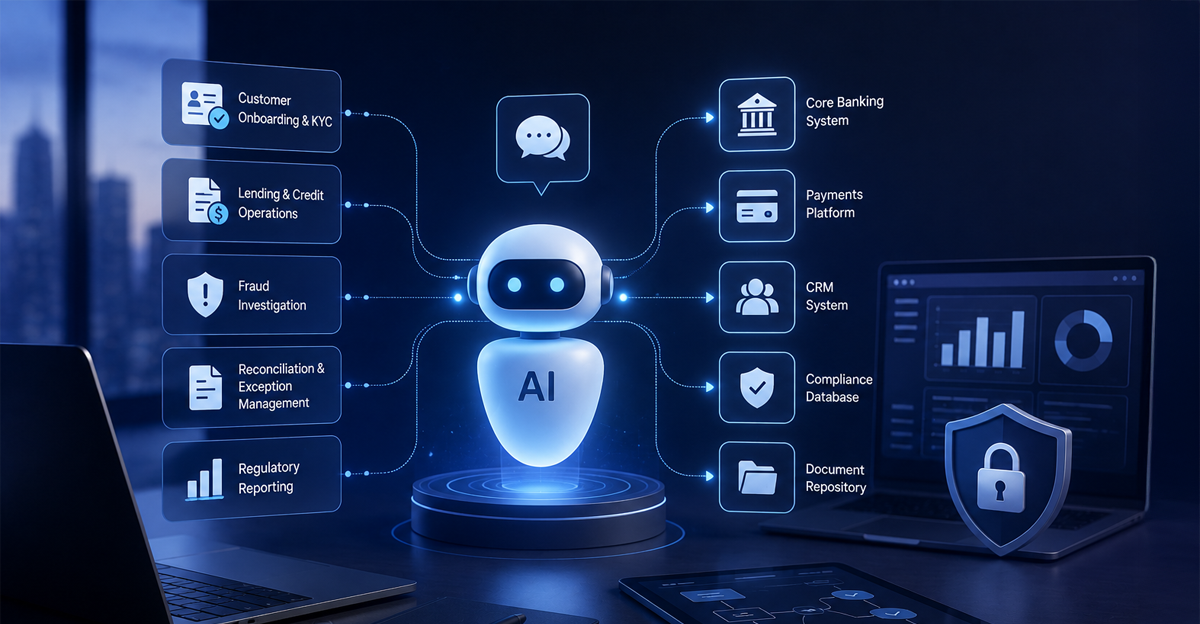
In financial services, an AI agent may connect with:
- Core banking platforms
- Payment processing systems
- Customer relationship management software
- Loan origination platforms
- Fraud monitoring tools
- Compliance databases
- Document repositories
- Accounting and reporting systems
AI Agents vs Traditional Financial Automation
| Area | Traditional Automation | AI Agents |
|---|---|---|
| Workflow structure | Fixed sequence | Adapts actions to context |
| Task complexity | Single, repetitive tasks | Multi-step financial processes |
| Data handling | Primarily structured data | Structured and unstructured data |
| Decision-making | Predefined rules | Rules, reasoning, and risk thresholds |
| System interaction | Limited integrations | Uses multiple connected tools |
| Exception handling | Sends most exceptions to employees | Investigates and categorizes exceptions |
| Human involvement | Frequent manual intervention | Oversight at defined checkpoints |
How AI Agents Support Autonomous Financial Operations
Customer Onboarding and KYC
- Collect application information
- Extract data from submitted documents
- Compare details across systems
- Identify missing or inconsistent information
- Request additional documents
- Prepare the case for compliance review
- Update the customer record after approval
Lending and Credit Operations
Fraud Investigation
Reconciliation and Exception Management
Regulatory Reporting and Compliance Support
Business Benefits of AI Agents in Financial Services
- Faster processing of routine financial operations
- Fewer manual handoffs between departments
- More consistent workflow execution
- Reduced administrative workload
- Better visibility into operational exceptions
- Faster customer response times
- Improved scalability during transaction spikes
- More complete process and decision logs
Risks of Autonomous AI Agents in FinTech
- Incorrect or unauthorized actions
- Exposure of sensitive financial data
- Inaccurate interpretations of customer requests
- Excessive access permissions
- Weak oversight of third-party AI providers
- Model drift and inconsistent performance
- Limited visibility into agent decisions
- Cascading failures across connected systems
Governance Requirements for Financial AI Agents
- Approved actions and prohibited actions
- Role-based access to systems and data
- Transaction and approval limits
- Human review requirements
- Complete action and decision logs
- Testing for accuracy, bias, and security
- Emergency shutdown and rollback procedures
- Continuous monitoring for unusual behavior
- Clear ownership for each deployed agent
How to Implement AI Agents in FinTech
Step 1: Choose a Controlled Workflow
Step 2: Define the Agent’s Authority
Step 3: Connect Enterprise Systems Securely
Step 4: Test Normal and Failure Scenarios
- Correct and incomplete inputs
- Conflicting information
- Unavailable systems
- Unauthorized requests
- Unexpected tool outputs
- High-risk financial actions
- Manual takeover procedures
Step 5: Expand Autonomy Gradually
KPIs for Measuring AI Agent Performance
- Average processing time
- Manual touches per case
- Straight-through processing rate
- Exception and escalation rate
- Agent task-completion rate
- Incorrect action rate
- Human override frequency
- Cost per completed process
- Customer response time
- Compliance or security incidents
Conclusion
However, greater autonomy requires stronger controls. Institutions should start with controlled use cases, limit agent permissions, maintain human oversight, and expand autonomy as performance and risk controls are proven.
Build Secure AI Agents for Financial Operations
Deploy AI agents and intelligent workflows that automate complex financial processes while maintaining compliance, auditability, and human oversight.
Frequently Asked Questions
1. Are AI agents fully autonomous?
AI agents can complete approved tasks independently, but financial institutions should restrict their authority. Sensitive, regulated, or irreversible actions should include human approval.
2. Can AI agents work with legacy financial systems?
Yes. APIs, middleware, secure automation tools, and custom integrations can connect agents with legacy banking, payment, lending, and accounting platforms.
3. Will AI agents replace financial operations teams?
AI agents are more likely to change how teams work. They can handle routine coordination and administrative tasks while employees focus on judgment, customer relationships, exceptions, and risk management.
4. What is the best first use case for a financial AI agent?
A high-volume, low-risk workflow with measurable outcomes is usually the best starting point. Examples include document collection, reconciliation preparation, and internal case summarization.
5. How are AI agents different from chatbots?
A chatbot mainly responds to messages. An AI agent can perform actions, interact with tools, update systems, and manage multi-step workflows based on an assigned objective.
Check out our Social Media