
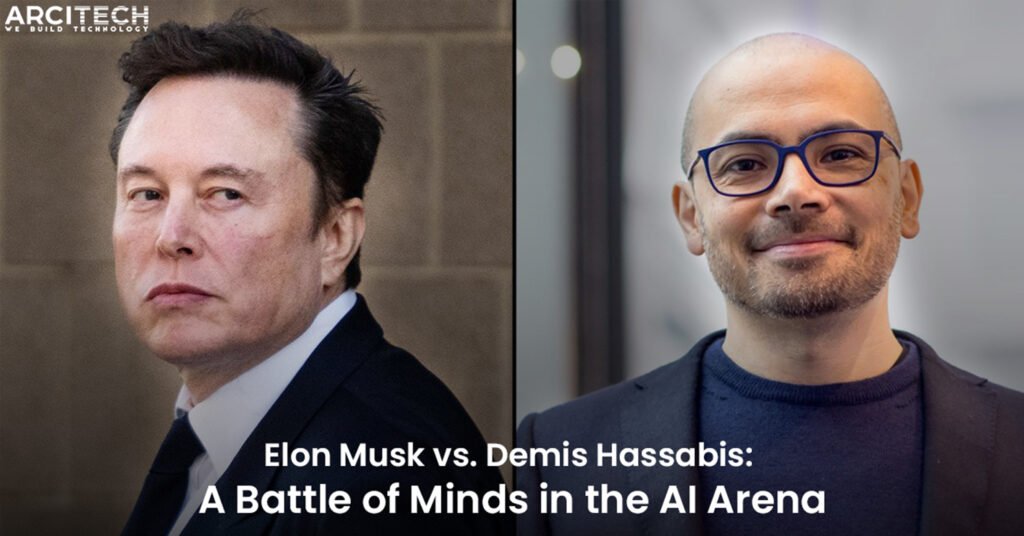
Few people have shaped modern artificial intelligence as much as Elon Musk and Sir Demis Hassabis, and few disagree so sharply about where it should go next. Musk is the serial entrepreneur behind Tesla, SpaceX, and the AI start-up xAI. Hassabis is the Nobel Prize-winning CEO of Google DeepMind. They once shared a vision. Today they stand on opposite sides of the defining question in tech.
That question is simple to ask and hard to answer: should we build advanced AI as fast as possible, or slow down to make it safe? Their falling-out is not just personal drama. It mirrors the central tension of the AI age, and in 2026 it reached a dramatic courtroom climax.
Who Are Elon Musk and Demis Hassabis?
| Profile | In brief |
|---|---|
| Elon Musk | Co-founder of Tesla and SpaceX; founded AI lab xAI (maker of Grok) in 2023. An early backer of both DeepMind and OpenAI. Longtime advocate for AI caution and regulation. |
| Demis Hassabis | Chess prodigy turned neuroscientist. Co-founded DeepMind in 2010; now CEO of Google DeepMind. Knighted in 2024 and shared the 2024 Nobel Prize in Chemistry for AlphaFold. |
| Shared ground | Both believe AI could transform civilisation. Both have warned about its risks. They split on how much caution that future demands. |
How Two AI Visionaries Became Allies
Hassabis co-founded DeepMind in 2010 with Shane Legg and Mustafa Suleyman, with a mission to “solve intelligence.” The London lab quickly attracted attention, and money.
Musk was one of its early investors, alongside Peter Thiel, Founders Fund, and Skype co-creator Jaan Tallinn. In those years the two men bonded over long conversations about the promise, and the danger, of building thinking machines. For a while, they were on the same side.
The Google Deal That Split Them
For Musk, handing a powerful AI lab to a profit-driven giant felt dangerous. He had already begun warning publicly that unchecked AI could pose an existential risk to humanity. Hassabis saw it differently: Google's resources meant DeepMind could scale its research and chase breakthroughs it could never fund alone.
Why Musk Built OpenAI
But the relationship soured. Musk left OpenAI's board in 2018 after failing to persuade the other founders to let him take control or fold the lab into Tesla. OpenAI later adopted a “capped-profit” model in 2019 to raise the capital it needed, and in 2025 converted into a public benefit corporation, a move Musk fiercely opposed.
Safety vs. Ambition: Two Philosophies
Strip away the personalities and a genuine philosophical divide remains. It is the same debate now playing out across the entire industry.
| Musk's stance | Hassabis's stance |
|---|---|
| Caution first | Progress first |
| Warns AGI could threaten humanity if rushed | Sees AI as the ultimate tool to solve science's hardest problems |
| Favours strict regulation and transparency | Focuses on responsible, in-house safety frameworks |
| Worries about power being concentrated | Argues focused, well-resourced labs can innovate responsibly |
Where the Rivalry Stands in 2026
Both men are now at the peak of their influence, and their paths have crossed again, this time as direct competitors.
Hassabis leads Google DeepMind, whose Gemini models now power products used by billions. In 2024 he was knighted for services to AI and shared the Nobel Prize in Chemistry with John Jumper for using AlphaFold to predict the structure of nearly every known protein. He expects artificial general intelligence to arrive around 2030.
Musk, meanwhile, launched xAI in 2023, putting him in direct competition with DeepMind. He also sued OpenAI, accusing it of betraying its non-profit mission. That case went to trial in Oakland, California, and on 18 May 2026 a jury ruled against him, finding he had waited too long to file. Musk called it a “technicality” and vowed to appeal.
So the sharpest open conflict today is really Musk versus OpenAI's Sam Altman. But with xAI and Google DeepMind now racing for the same prize, Musk and Hassabis remain rivals in the most literal sense.
What This Means for the AI Industry
- Governance is now a courtroom issue. The OpenAI verdict is being read as a template for how every frontier AI lab structures itself.
- Open vs. closed is unresolved. Musk's original push for “open” AI sits awkwardly against today's guarded, commercial reality, including at his own companies.
- Speed vs. safety is mainstream. What was once a niche debate between two founders is now shaping policy, regulation, and public opinion worldwide.
Key Takeaways
- Musk and Hassabis started as allies. Musk was an early DeepMind investor before Google acquired it in 2014.
- Their split reflects a real divide: Musk prioritises caution and control, while Hassabis prioritises scientific progress.
- Hassabis is now a knighted Nobel laureate leading Google DeepMind; Musk runs xAI and lost his 2026 lawsuit against OpenAI (he is appealing).
- The rivalry is a microcosm of the whole industry's central question: how fast is too fast?
Frequently Asked Questions
1. Did Elon Musk win his lawsuit against OpenAI?
No. On 18 May 2026, a jury ruled against Musk, finding he had filed his claims after the legal deadline had passed. The judge accepted the verdict. Musk has said he will appeal.
2. Why did Elon Musk leave OpenAI?
Musk left OpenAI's board in 2018 after the other co-founders rejected his push to take control of the organisation or merge it into Tesla. He later stopped funding it, deepening the rift.
3. Are Elon Musk and Demis Hassabis rivals?
Yes, in two ways. They hold opposing philosophies on AI safety, and since Musk founded xAI in 2023, his lab competes directly with Hassabis's Google DeepMind.
4. What did Demis Hassabis win the Nobel Prize for?
He shared the 2024 Nobel Prize in Chemistry with John Jumper for AlphaFold, an AI system that predicts the 3D structure of proteins, solving a 50-year-old scientific challenge.
5. Who owns DeepMind now?
Google. It acquired DeepMind in 2014 and, in 2023, merged it with Google Brain to form Google DeepMind, which Hassabis leads.